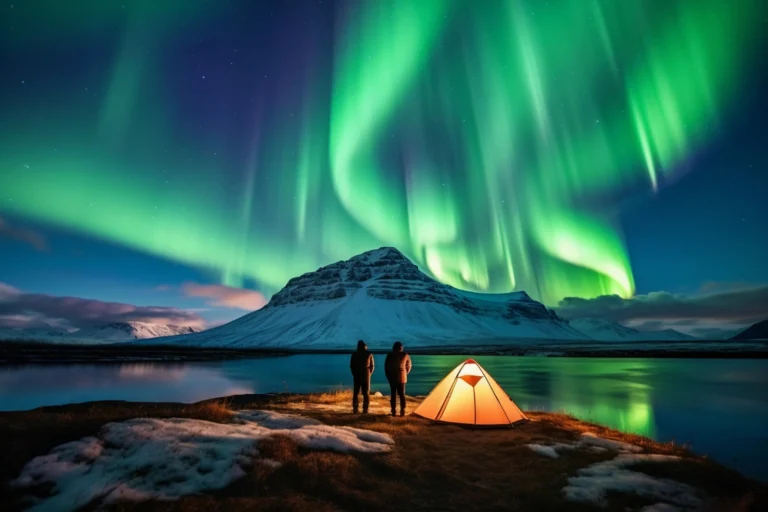
Speak to any devoted aurora follower about that threshold moment when the night begins to move, and they will recount it with a hushed, almost spiritual gravity. A colourless shimmer, barely perceptible—easily mistaken for a smudge on your lenses—starts to stir. It intensifies, swelling into a glowing green veil that undulates as if drawn by an invisible breeze, bright enough to etch shadows into the snow.
For UK residents searching for the best place to see the Northern Lights in Eurasia, the conventional returns have invariably been Reykjavík or Tromsø. However, the approaching 2026/27 winter demands a recalibration. Escalating Scandinavian expenses, suffocating visitor numbers at once-peaceful observation points, and a dawning realisation that the most consistent, budget-conscious, and unspoilt aurora encounters are tucked far to the east are reshaping the winter travel landscape.
The lights themselves are blind to marketing; they answer exclusively to geomagnetic latitude, the solar wind, and an unclouded atmosphere. Deep within Arctic Russia, those three conditions converge with a purity that Western Europe’s commercialised aurora infrastructure can no longer match.
Table of Contents
A Comparative Overview of Eurasia’s Key Aurora Regions
Let’s put aside the glossy brochures and scrutinise the objective figures. The appraisal below weighs the main Eurasian aurora territories against the benchmarks that really determine a successful outcome—and the state of your finances.
| Destination | Aurora Probability & Weather | Crowd Density & Ambience | Affordability (for UK Travellers) | Overall Verdict |
| Russia (Kola Peninsula) | Excellent (Stable continental climate, clear skies inland) | Very Low (Uncrowded, highly private viewings) | Outstanding (£140–£190 glass domes, £60–£85 city hotels) | Best overall value and wilderness experience |
| Norway (Tromsø) | Very Good (Coastal climate, subject to sudden clouding) | Very High (Congested viewpoints, mass tour buses) | Very Poor (£155+ hotels, double UK food prices) | Beautiful scenery but highly congested and costly |
| Finland (Lapland) | Very Good (Reliable winter cold, high visibility) | High (Highly commercialised, busy resort zones) | Poor (£480–£800 glass igloos, high-season premiums) | Good for families; extremely expensive |
| Iceland (Reykjavík/South) | Poor to Moderate (65–75% cloud cover in midwinter) | Moderate (Popular spots can get busy) | Poor (£15–£18 soup, expensive car rentals) | High meteorological risk for a dedicated chase |
| Sweden (Abisko) | Good (Rain-shadow effect improves clear skies) | Low (Remote, quiet settlement) | Moderate to Poor (Costly multi-stage travel from UK) | Clear skies but highly limited off-night activities |
The pattern is clear. Russia’s Kola Peninsula, anchored by Murmansk, combines the highest probability of cloud-free winter nights with a price level that feels strikingly out of date—and manages this without the fleets of buses and the dense forest of tripods that now typify the Nordic route. Anybody investigating the best countries to witness the Northern Lights outside Scandinavia will find their compass pointing resolutely east.
1. Russia: Eurasia’s Leading Light in Aurora Viewing
This is not some freshly unearthed frontier; it is the most underappreciated gem that is now catching the light. The Kola Peninsula, a rough wedge of land thrust into the Barents Sea, lies at 68° north latitude—squarely within the auroral oval, that band of intensified geomagnetic activity where displays hit their peak regularity and radiance. While Scandinavia’s coastal towns grapple with the mild, moisture-laden air of the Gulf Stream, the Kola profits from a continental microclimate that delivers long stretches of dry, severe cold. When the heavens are perfectly clear and the solar particles arrive, what unfolds above is not a timid smear at the horizon but an all-sky spectacle that can last for multiple hours.
Murmansk and the Kola Peninsula: The World’s Most Populous Arctic Hub
Murmansk claims the title of the largest city on the planet above the Arctic Circle, a working harbour of about 300,000 inhabitants. On the surface, an industrial port may appear an odd base for a backcountry aurora mission. Yet that very duality is its secret weapon. You are cushioned by urban amenities—modern medical services, internationally branded hotels, fine restaurants, robust mobile signal—while a drive of just 30 to 40 minutes removes you from every trace of artificial glow. The roads are carefully maintained all winter, and local guides know the exact hollows where the land opens onto frozen lakes and bare tundra, granting a sweeping 360-degree prospect of the sky.
What turns the peninsula into such a persuasive answer for those wondering how to pair Northern Lights viewing with Arctic winter holidays is the sheer density of adventures packed into a compact area. Daylight is not a tedious countdown to dusk. While the sun lingers low, you can probe one of the continent’s most varied and dramatic Arctic settings; once darkness falls, you are stationed beneath some of the most transparent skies in Eurasia.
Cost-Effective Arctic Indulgence: Glass-Ceilinged Lodges and Snug Retreats
A stubborn narrative in aurora tourism insists that the display must be earned through physical discomfort—standing rigid at -30°C, clapping hands and hoping the clouds fracture. Finland famously broke that myth with the heated glass igloo, a transparent cocoon that lets you survey the sky from beneath a duvet. In recent years, that concept has taken root on the Kola Peninsula and is now flourishing in a way that drastically undercuts the Nordic price structure.
A panoramic glass igloo or heated dome on the Kola—complete with a crystal-clear roof suspended above a double bed, a private washroom, and often a wood-burning sauna—costs between £140 and £190 per night for two people. An equivalent experience at Kakslauttanen or Levin Iglut in Finnish Lapland now fetches £480–£800 per night during the core aurora months, frequently with meals charged separately. Within Russia, your dome or igloo rate customarily includes breakfast, occasionally a three-course dinner, and an aurora notification arrangement—either a staff member who stays awake or an automated sensor that alerts you when the first ripple appears. You are spared the grind of fixating on the ceiling for six straight hours.
The accent on warmth extends further. Russian aurora lodges have honed what might be called the “comfort chase.” Instead of loitering numbly in a lay-by, you can withdraw into a heated chum (a traditional teepee-style tent with a crackling stove), cradle a steaming mug of tea, and wait for the guide’s signal. Once the lights ignite, you stroll outside for a twenty-minute burst of photography and awe, then slip back inside to thaw your fingers. This is a fundamentally softer, more refined means of pursuing the aurora, converting the venture from a test of stamina into a source of genuine enjoyment. For UK travellers asking where they can experience the Aurora Borealis in winter without the Nordic premium, the Kola’s glass-igloo grouping is the definitive solution.
Daylight Diversions: The Arctic Shore, Dog Mushing, and Saami Traditions
An aurora-oriented holiday cannot survive on darkness alone. The Kola Peninsula enriches the daylight hours with a portfolio of activities that range from culturally immersive to physically invigorating. The selection below illustrates what a well-constructed three-day plan might encompass while the sun is up:
- Saami cultural encounter: The indigenous Saami have herded reindeer across the Kola Peninsula for thousands of years. At a traditional settlement, you can hand-feed the animals, listen to the ancient vocal art of joik, and gain insight into a lifestyle that endured the Soviet period and is now enjoying a spirited cultural revival. You will be welcomed into a lavvu tent, warmed by a central fire, and offered flatbread and hot berry cordial—a living tradition, not a theatrical show.
- Arctic Ocean coast at Teriberka: A two-hour road journey from Murmansk brings you to this starkly scenic fishing hamlet on the Barents Sea, immortalised by the film Leviathan. Walk a beach of black sand littered with grounded icebergs, frame images of the decaying wooden boats locked into the tide line, and observe North Atlantic swells detonating against snow-clad boulders. During the polar night, the low-angled sun paints everything in shades of indigo and violet that captivate photographers.
- Husky sledging across the tundra: A team of Siberian huskies, quivering with eagerness, awaits at a kennel. Following a brief handling lesson, you seize the reins and steer the sledge across a frozen lake, the silence broken only by the rhythmic breathing of the dogs and the soft whisper of runners on packed powder. Outings range from a one-hour taster to a full-day journey with a campfire meal, and the connection formed with the animals in just a few hours is remarkably touching.
- Snowmobile safaris to hidden lookouts: Modern snowmobiles open up terrain that no wheeled vehicle can access. A guided night safari can carry you deep into the tundra, far from any artificial gleam, to witness the aurora in total solitude. Daytime excursions traverse the frozen breadth of Lake Imandra or climb into the foothills of the Khibiny Mountains, unveiling a panorama of white wilderness that stretches to every horizon.
- Kamchatka crab safari on a frozen inlet: The Barents Sea supports a vast population of Kamchatka crab, introduced by Soviet marine biologists and now flourishing. A crab safari entails drilling through a metre of ice, raising baited pots, and then feasting on the sweet, delicate meat cooked on a portable stove directly on the ice. The flavour is startlingly fresh—a universe removed from any crab you have sampled in Britain.
- Ice fishing on a silent lake: For a more measured pace, accompany a local angler, drill a hole through the ice, and suspend a line for Arctic char or perch. Even if the fish remain elusive, the meditative quiet of sitting on a frozen lake, encircled by snow-laden forest, is a powerful countermeasure to a mind fatigued by ceaseless stimulus.
When the aurora eventually swirls across the heavens, it arrives not as the sole reason for an otherwise hollow trip but as the crowning moment of a day already filled with Arctic exploration.
Aurora Photography for Beginners: Core Techniques
Photographing the aurora has a reputation for being technically demanding, but with contemporary camera gear and a handful of basic rules, you can return home with images that do justice to what your eyes witnessed. Here are the fundamental practices:
- Opt for a camera with manual settings: A DSLR or mirrorless body is preferred, though many recent smartphones now offer dedicated night or astrophotography modes that can produce acceptable results. If using a phone, pair it with a small tripod and a Bluetooth remote release.
- Pick a wide, fast lens: The broader and brighter, the better. A focal length of 14–24 mm combined with a maximum aperture of f/2.8 or faster (f/1.8, f/1.4) gathers more light and frames a wider section of sky. If you only have a kit zoom, set it to its widest angle and most open aperture.
- Nail your focus manually: Autofocus falters in near-darkness. Switch to manual, rotate the ring to the infinity mark, then ease it back slightly. Take a test exposure of a bright star and magnify the preview to confirm sharpness. Once set, secure the ring with tape so the cold does not knock it out of position.
- Adjust exposure settings: Start with a shutter speed of 5–10 seconds, the lens wide open, and ISO between 800 and 3200. Modify according to the aurora’s vigour: a rapid, bright display requires shorter exposures to prevent the curtains from blurring, while a faint, slow-moving glow can tolerate 15–20 seconds.
- Use a robust tripod: This is non-negotiable. A solid tripod that can be erected swiftly while wearing gloves is worth its weight. Carbon-fibre legs are lighter and far less uncomfortable to handle in sub-zero temperatures than aluminium.
- Carry spare batteries: Cold weather drains power quickly. Keep at least two or three fully charged spare cells in an interior pocket close to your body, and swap them as soon as the charge indicator drops.
- Incorporate foreground elements: A sky ablaze with colour is dramatic, but the most enduring photographs include foreground details—a silhouetted tree, a warmly lit glass dome, a human figure looking upwards—that provide scale and emotional weight. Reconnoitre your position during daylight so you know exactly where to set up after dark.
- Insulate for long waits: Photography demands extended periods of stillness, so you need more insulation than someone who is moving. Chemical hand warmers placed inside gloves and boots are an inexpensive, effective method of keeping fingers and toes operational.
A grasp of these core principles, paired with contemporary equipment, turns the challenge of aurora photography into an achievable and deeply satisfying pursuit.
Simplified Travel Logistics: E-Visas and Air Connections
The traditional mental obstacle of a Russian visa has largely disappeared. A unified electronic visa (e-visa) system, functioning smoothly since 2023, allows UK passport holders to apply entirely online for a tourist stay of up to 16 days. The process is notably simple: fill in a short digital form with your personal details and a passport-style photograph, pay the £45 fee electronically, and receive approval within approximately four calendar days—no invitation letters, no consular appointments, no couriered documents. Print the PDF confirmation and show it alongside your passport at the border.
Air links from the UK to Murmansk are practical and, with reasonable advance purchase, competitively priced. Typical routings use Turkish Airlines via Istanbul or Emirates via Dubai. Total travel time from London or Manchester is usually 10 to 12 hours, including a relaxed stopover. Return fares for the 2026/27 winter season can be secured from around £450–£650—on a par with flights to northern Norway and often cheaper than Iceland during the aurora peak. On arrival at Murmansk International Airport, a pre-booked transfer will have you at a city-centre hotel within 40 minutes or a tundra lodge inside two hours.
The final component is the local guide. Russian aurora guides have built a reputation for persistence and a detailed knowledge of local weather microclimates. They monitor satellite feeds, maintain radio contact with colleagues spread across the peninsula, and are prepared to drive significant distances to locate a break in the cloud. Most speak fluent English, and the top operators bundle all transfers, meals, and cold-weather clothing into their package rates, enabling you to travel light while staying comfortably warm.
2. Northern Scandinavia: Majestic but Expensive and Overrun
Let us be clear: northern Scandinavia is still a naturally favoured aurora territory. The Swedish interior near Abisko, the Norwegian coastline around Tromsø, and the highlands of Finnish Lapland all sit at suitable geomagnetic latitudes and are fully capable of producing spectacular displays. The issue in 2026 is not physical geography but economic pressure and sheer human density.
Tromsø has sagged under the weight of its own fame. On a busy winter night, fleets of tour coaches and minibuses pour out of the city along the same arterial roads, clustering at a limited set of known viewing spots. An encounter that once felt like a private audience with the Arctic night now often resembles a coach trip, complete with camera flashes and guides straining to be heard above the wind. The financial damage is steep. A three-hour minibus Northern Lights chase in Tromsø costs £110–£130 per person. A basic hotel room starts at £155 per night. A simple evening meal for two with one glass of wine routinely tops £100. A couple flying from the UK for a four-night aurora break in Tromsø should budget at least £2,500–£3,000—and there is still no promise of a gap in the clouds.
Finnish Lapland, meanwhile, has been transformed by the unrelenting push of Santa-themed tourism and glass-igloo accommodation. Rovaniemi now ranks among the most heavily visited winter destinations in all of Europe, and the infrastructure buckles under the strain. Glass igloos are reserved more than twelve months ahead, and the premium attached to the Finnish label brings no corresponding rise in the likelihood of actually seeing the lights. The sky overhead is unchanged; only the price tag is inflated.
Swedish Lapland, particularly the area around Abisko, profits from a rain-shadow effect that sometimes delivers clearer conditions than the Norwegian coast. Yet Abisko remains a tiny, isolated hamlet with scarce lodging and few daytime diversions beyond the aurora. For a multi-day holiday, the choices rapidly shrink, and reaching the village from the UK entails multiple flights followed by a train trip or a lengthy transfer—swallowing both time and budget. For anyone aiming to combine Northern Lights viewing with an Arctic winter break, Scandinavia certainly provides a fine light show, but its supporting cast is thin and costly.
3. Iceland: Striking Scenery Hampered by Relentless Cloud
Iceland’s volcanic scenery is unarguably photogenic, and the country has marketed itself shrewdly as an aurora hotspot. The catch is that the very North Atlantic weather systems that keep the island relatively temperate in winter also generate near-constant cloud cover. Reykjavík and the southern shore, where the bulk of visitors stay, lie directly in the track of low-pressure systems barrelling in from the ocean. Icelandic Met Office statistics show that during the core winter months of December and January, the sky is overcast for 65–75% of dark hours.
In practical terms, a UK traveller who books a week-long aurora-hunting trip to Iceland faces a very tangible chance of encountering little beyond grey skies. Certainly, you can hike a vehicle and drive for hours chasing a break, and the landscapes along the way are often spectacular, but the central purpose of the journey—seeing the Northern Lights—becomes a bet tilted against you. Layer on Iceland’s notoriously high expenses (a modest bowl of soup in a casual café costs £15–£18, a rental car with studded winter tyres runs £80–£100 per day), and the value equation quickly disintegrates. Iceland is a superb country to explore in its own right, but as a dedicated aurora base, its cloud-cover figures make it the chanciest option on this list. The stable, frigid, continental climate of the Kola Peninsula offers a fundamentally different—and materially more reliable—proposition.
Aurora Forecasting: Understanding the KP Index and Key Tools
A small amount of scientific knowledge can noticeably improve your odds of a sighting and lend a satisfying intellectual dimension to the chase. Below are the essential elements every aurora hunter should absorb before confirming a reservation:
- Decoding the KP Index: This metric spans 0 to 9, gauging geomagnetic turbulence. At KP 0–1, activity is minimal and typically restricted to latitudes above 70° north. At KP 3–4, the oval broadens, brightening the skies over the Kola Peninsula to levels a camera can easily register. KP 5 and above indicates a geomagnetic storm, with fast, multicoloured curtains potentially visible far further south. From a base at 68° north, even a KP of 2 can generate a satisfying display when the air is transparent.
- Solar Cycle 25 positioning: We are still in the rising phase of Solar Cycle 25, which started in 2019. Solar activity—sunspot numbers, coronal mass ejections—is projected to peak around 2025–2026, with heightened levels persisting through the 2026/27 winter. The next two aurora seasons consequently sit among the most favourable in over a decade.
- Trustworthy forecasting resources: Install the Aurora app or visit the Space Weather Prediction Center (NOAA) site, both of which supply 30-minute and three-day outlooks. For live decision-making, the Glendale app and local guide networks that interpret real-time satellite data are priceless. Monitor not only the KP value but also the Bz component of the interplanetary magnetic field; when Bz leans southward (negative), the aurora flares dramatically.
- Cloud-cover surveillance: Cloud conditions often outweigh KP readings in significance. A high index is worthless if the sky is blanketed. Use Windy.com or Yr.no for cloud-cover predictions tailored to your position. The Kola Peninsula benefits from the Murmansk Coastal Current, which frequently maintains clear skies just inland while the adjacent Barents coast stays overcast—a subtlety that adept local guides exploit to great advantage.
- Darkness duration: The aurora season stretches from late August to early April, when nights are sufficiently dark. For UK travellers, the optimal window is December through March. On the Kola Peninsula, the polar night grips from early December until mid-January, with the sun never fully climbing, creating an exceptionally long stretch of darkness that optimises your chances.
Equipped with these forecasting insights, the wait for the aurora shifts from a passive hope to an informed strategy, though nature always retains the final word.
Conclusion: Selecting the Right Destination for Your Aurora Voyage
The Northern Lights are a whim of the natural world; no patch of ground on the planet can offer a cast-iron promise. What a location can provide—or fail to supply—is a reliable combination of clear skies, fair pricing, comfortable amenities, and a sense of authentic discovery. As you mould your aurora plans for the 2026/27 season, the weight of evidence shifts firmly away from the increasingly strained Nordic and Icelandic fixtures.
The Kola Peninsula meets every significant benchmark. Its latitude places it squarely within the most luminous segment of the auroral oval. Its continental climate produces extended spells of cloudless, deeply frozen weather that maritime destinations can only envy. Its tourism infrastructure has developed quickly, replicating the glass-igloo luxury and warm-chase ease that Finland popularised, but at one-third to one-quarter of the cost. And its daytime activities—husky sledging, Arctic Ocean excursions, Saami cultural encounters, crab safaris on the ice—transform an aurora expedition from a one-dimensional vigil into a layered, profoundly satisfying winter retreat.
If you have been searching for the best place to see the Northern Lights in Eurasia, the answer for the approaching season is no longer a familiar Scandinavian brand. It is a region that fuses untamed Arctic authenticity with present-day comfort, limitless wilderness with straightforward e-visa entry, and world-class aurora potential with an invoice that still permits an extra night or two. Secure your seat to Murmansk, pack your warmest clothing, and prepare for a sky that will etch itself into your memory long after your return.
Also Read : What to Do in Nashville During CMA Fest Weekend
Frequently Asked Questions (FAQ)
Which Eurasian country is the most budget-friendly for an aurora trip?
By a substantial margin, Russia’s Kola Peninsula is the most economical base for a premium Northern Lights holiday in Eurasia. The mix of low-cost accommodation, guided activities priced well below their Scandinavian counterparts, and a Pound-to-Rouble exchange rate that works in the UK traveller’s favour makes a high-calibre aurora experience attainable without financial worry. A full week in a glass-roofed lodge with daily excursions and meals will generally cost less than merely flights and a hotel in Tromsø or Reykjavík.
How many nights should I stay to maximise my chances of seeing the Northern Lights?
No duration offers an absolute certainty, but a stay of three to four nights provides a strong statistical probability when the weather is favourable. The aurora hinges on solar activity and local cloud cover, so building several nights into your schedule is prudent. A longer visit also enables your guide to select the most promising evening for a dedicated pursuit and to adjust to shifting weather patterns. If your diary and budget allow, five to six nights will optimise your prospects and let you settle into the slower Arctic rhythm.
Is it unbearably cold to watch the aurora in the Russian Arctic?
Not when you prepare thoughtfully and select suitable lodging. Midwinter temperatures on the Kola Peninsula ordinarily fall between -10°C and -25°C during the aurora season, a range that contemporary insulated clothing handles with ease. More importantly, the spread of heated glass igloos, panoramic domes, and warm-chase facilities means you can follow the display from a snug indoor position, venturing outside only when activity strengthens. Reputable local guides supply high-quality thermal suits, boots, and mittens, so even extended periods outdoors remain comfortable.
Can you watch the Northern Lights from a glass igloo in Russia?
Yes—this has evolved into one of the Kola Peninsula’s signature draws. A growing number of dedicated aurora lodges and glamping sites operate heated, glass-roofed igloos and domes positioned far from artificial light sources. These permit you to lie in a warm bed while the celestial performance unfolds overhead. When booking, verify that the dome provides a transparent roof with a viewing angle of 180 degrees or greater, and enquire whether the property operates an aurora wake-up call system. That small detail can be the distinction between a restful night and missing a display of a lifetime.
Disclaimer: All prices quoted in this guide are approximate and reflect the 2026/27 winter season. Actual costs fluctuate according to exchange rates, availability, and the pricing policies of individual operators. Always confirm current rates directly with your chosen service providers before finalising any booking.